
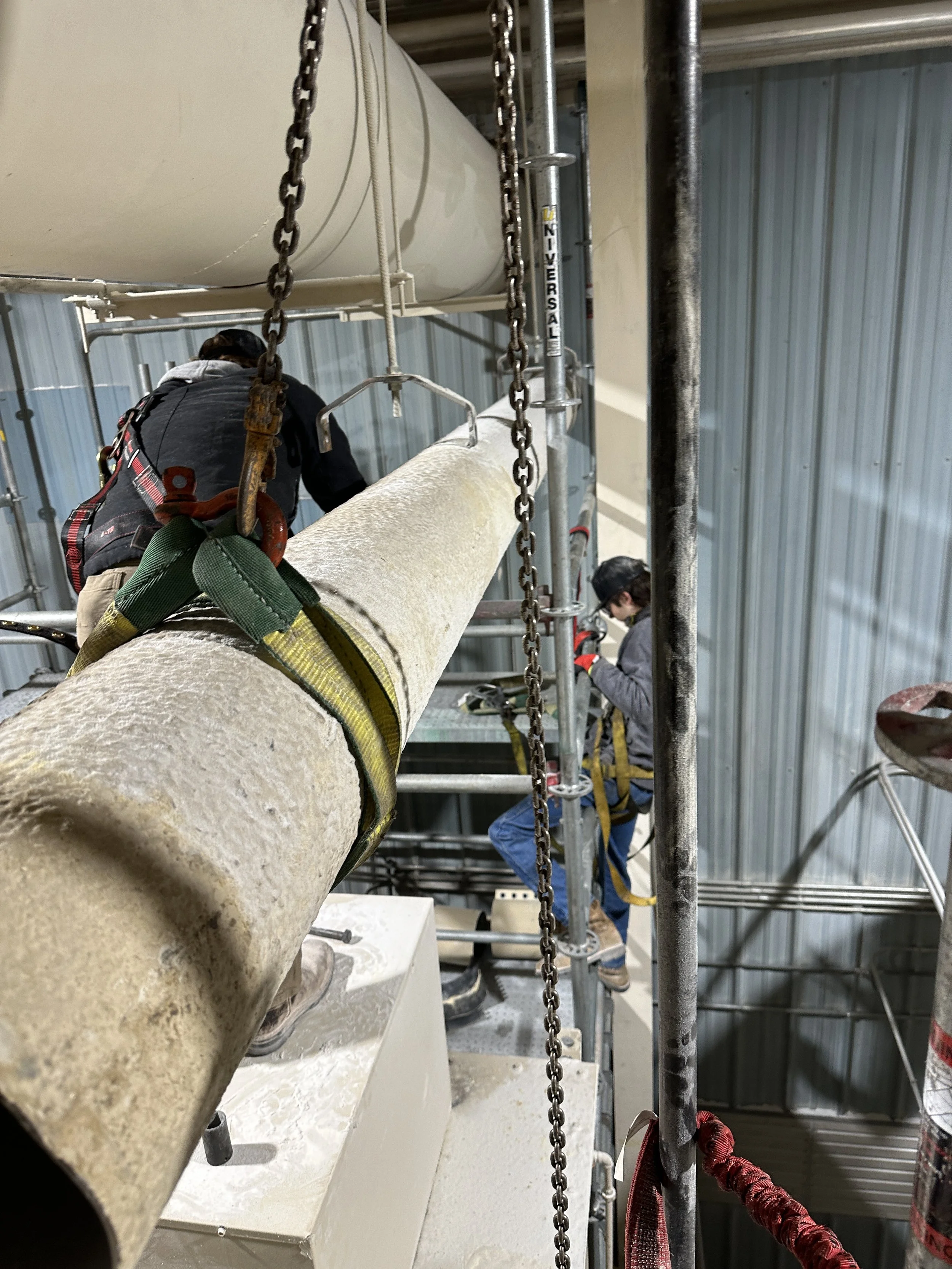
How to fix a critical process dust collector leak
Inspecting ductwork
How to Fix a Critical Process Dust Collector Leak
Industrial dust collector leaks can disrupt your entire operation, stall production, and create safety hazards. When a critical process dust collector starts leaking, finding the root cause quickly is essential.
While an old or worn-out filter is often the culprit, leaks can happen for many different reasons. If a system that traditionally performed well suddenly starts leaking, something in your process has changed.
Before opening up your system, use this troubleshooting guide to identify, fix, and prevent industrial dust collector leaks.
1. Trace Recent System Changes
Before inspecting internal components, analyze all changes made to your facility prior to the leak. Ask yourself the following questions:
Was recent maintenance performed? Check for recent additions or service done to the ductwork, dust collection hoods, dust collector cartridges, or bag filter cleaning mechanisms.
Who managed the change? Identify who completed the work to see if any specific protocols were altered.
Did the system velocity change? Consider the dust transport velocity in each section of your ductwork.
2. Evaluate Air Velocity and Abrasion
If air speeds up unexpectedly within your system, it can cause severe internal damage. High velocity leads to accelerated wear and tear, causing leaks that are not directly related to a bad filter at the end of its useful life.
Increased velocity often causes severe abrasion to:
Metal elbows in the ductwork
Dust collector filters and pleated elements
Dust baffle plates in the dust collector hopper
Dust collector filter seals
3. Inspect Filter Integrity and Sealing Points
Do not just look at the fabric integrity of your filters; always check the filter sealing point.
Many dust collector leaks stem directly from improper filter installation. Because precise alignment is required to ensure a perfect seal, it is always best to let qualified technicians with years of industrial filtration experience handle the installation process.
4. Run a Baghouse UV Dye Leak Test
If your final product allows for it, a simple troubleshooting exercise with baghouse UV dye can quickly pinpoint the exact location of a leak.
Verify compatibility: Check if using a standard UV dye product is safe for the specific material your baghouse or dust collector is processing.
Simulate real conditions: Once new filters are installed, perform a dust collector UV dye filter leak test.
Run at full capacity: Always conduct this test while the system operates at the exact same level as it does during normal, peak production.
5. Prepare for Dust Collector Emergencies
To minimize costly downtime, your facility should always maintain a proactive emergency response plan:
Keep spare parts in stock: Always store one spare set of dust collector filters, dust collector cartridges, dust collector pleated elements, or baghouse bags in your storeroom.
Partner with a vetted service provider: Utilize an experienced, reliable baghouse and dust collector service company that is already set up in your corporate purchasing system. This saves valuable time during an emergency service call-out or parts order.
Build personal relationships: Establish a first-name basis relationship with your service and parts supplier, and save their personal cell phone numbers for after-hours needs.
Need an Industrial Dust Collector Expert?
If you need a dust collector and baghouse expert with over 30 years of industry experience, Faulkner Industrial is ready to help. We handle all of your after-hours emergency dust collector repairs and baghouse servicing needs. If repairs to your current system are no longer viable, we also provide and install completely new dust collector and baghouse systems tailored to your facility.
Contact Wade Faulkner today to secure your reliable filtration partner before the next emergency strikes.
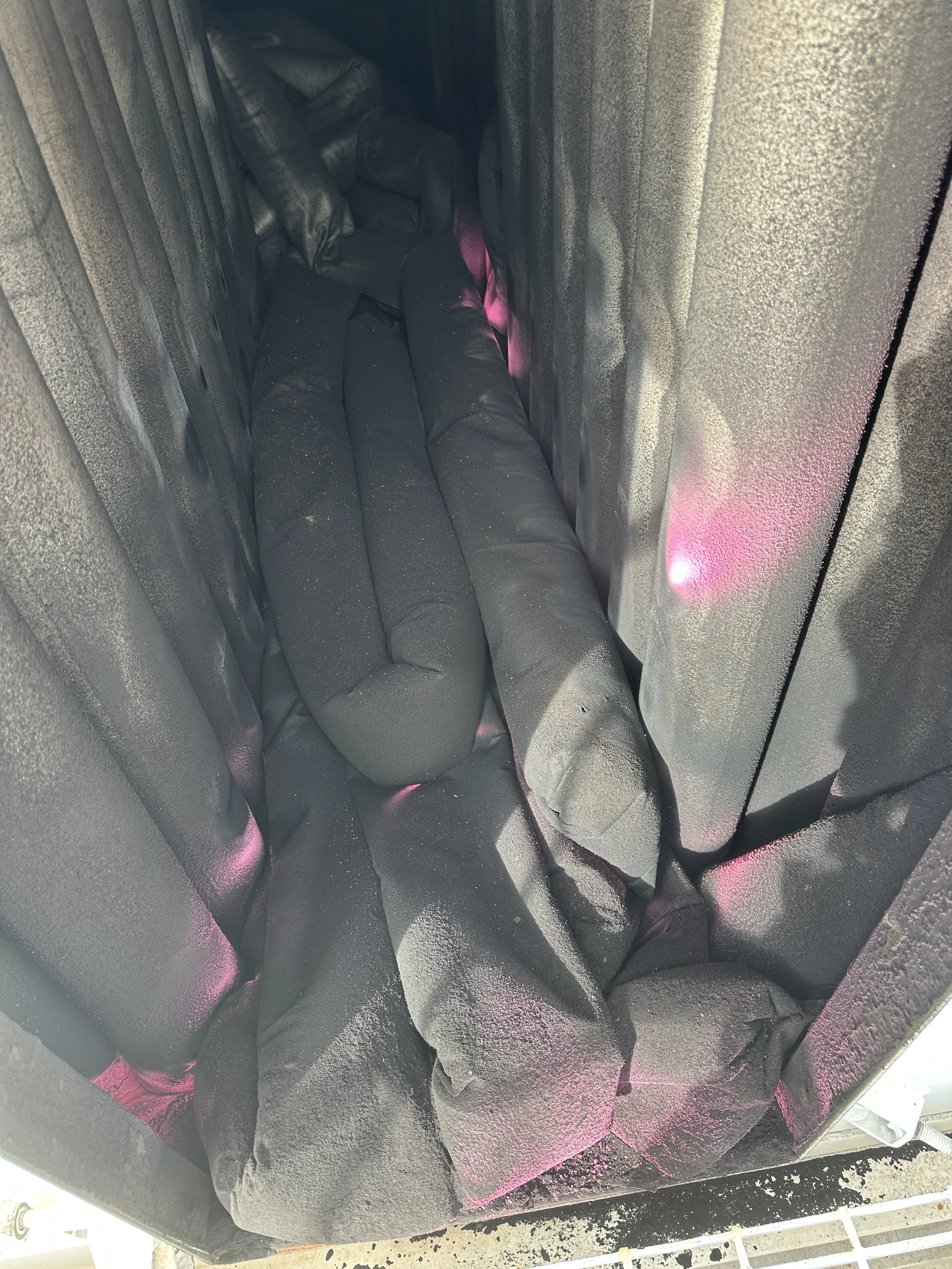
UV Dye Leak Testing for Baghouse Bags and Dust Collector Filters: Reduce Downtime and Find Leaks Faster
In manufacturing, every minute of downtime costs money. When a baghouse or dust collector develops a leak, the result can be visible stack emissions, failed compliance testing, lost production, and costly maintenance. Finding the exact source of the problem quickly is essential—but without the right tools, leak detection can become a time-consuming process of trial and error.
That's where Faulkner Industrial's HOLE CHASER® UV Dye Leak Detection System makes the difference.
Quickly Locate Leaks in Baghouse Bags and Dust Collector Filters
For more than 30 years, Faulkner Industrial has helped manufacturers identify and repair leaks in baghouse filters and dust collection systems. Our HOLE CHASER® UV dye has been trusted by hundreds of facilities worldwide to reduce maintenance time, minimize labor costs, and get equipment back online faster.
The UV dye is available in:
1-gallon containers
3.5-gallon containers
55-gallon drums for large-scale operations
The dye is injected into the dirty air stream, allowing it to travel through the system just as process dust normally would. After the system is shut down and all required lockout/tagout and safety procedures have been completed, technicians enter the baghouse with the correct UV inspection light.
Under the proper UV wavelength, the dye clearly identifies the source of leaks, making damaged filter bags, failed seals, and other problem areas easy to locate.
Why the Right UV Light Matters
Not all UV lights are designed for industrial leak detection.
Many UV lights marketed for this purpose do not emit the proper wavelength needed to activate the dye effectively. This can make inspections frustrating and lead technicians to believe the process doesn't work.
At Faulkner Industrial, we help ensure you have the correct UV dye and inspection equipment for accurate, reliable leak detection. Using the proper tools dramatically improves inspection speed and results.
Why UV Dye Testing Is More Accurate Than Visual Inspections
Without UV dye, maintenance personnel often have no reliable way to pinpoint where a leak actually originates.
Dust can accumulate in low-airflow or "dead" areas inside a baghouse, making it appear that a leak exists where none actually does. As a result, maintenance teams may replace perfectly good filter bags while the real source of the leak remains unresolved.
This unnecessary maintenance can become especially expensive when high-temperature or specialty filter bags are involved.
UV dye testing eliminates the guesswork by showing technicians exactly where repairs are needed, helping reduce:
Unnecessary filter replacement
Maintenance labor hours
Equipment downtime
Employee exposure to hot, dusty environments
Lost production due to extended outages
Experienced Baghouse Leak Detection and Repair
With more than three decades of experience, Faulkner Industrial specializes in UV dye leak inspections, baghouse repair, and dust collector troubleshooting.
Our experienced technicians can often locate and repair leaks quickly, allowing your maintenance staff to focus on other critical work during scheduled outages or unexpected shutdowns.
Prepare for Stack Testing and Environmental Compliance
Many manufacturing facilities are required to perform stack testing to meet EPA and state environmental regulations.
Scheduling a UV dye leak inspection before stack testing can help identify leaks before they become compliance issues. Repairing damaged filters and sealing leaks ahead of testing increases the likelihood of passing inspections while reducing the risk of costly delays or repeat testing.
Schedule Your UV Dye Leak Test Today
If your facility is experiencing visible emissions, unexplained dust leaks, or you're preparing for stack testing, Faulkner Industrial can help.
Our experienced team provides fast, accurate UV dye leak testing for baghouses and dust collection systems, helping you reduce downtime, improve maintenance efficiency, and keep your operation running at peak performance.
Call Faulkner Industrial today at 1-800-817-1668 to schedule your UV dye leak inspection or learn more about the HOLE CHASER® UV Dye Leak Detection System.
Time for a Baghouse Filter Change?
How do you determine when your filters need to be changed?
If your new to baghouse and dust collector maintenance, determining the intervals of bag filter change outs or cartridge filter change outs shouldn’t be something to cause too much anxiety for you. There are a few ways to determine the correct intervals.
Generally, it is a function of differential pressure on systems that are not leaking. The differential pressure on your manometer will increase and remain at an elevated level even though your filtration cleaning system is doing its job. When this happens, the filters have reached their useful life. The dust has impregnated the fibers of the fabric and will not clean back down. A new set of filters will get you back within normal parameters of your system.
You can also rely on history if your plant production has remained relatively the same over several years. Most maintenance departments have established intervals whereby ongoing maintenance to the baghouse filters is minimized. We often see plants with yearly change out schedules. Some industries can extend these intervals, especially if the filters are not operating at high temperatures or in an environment where they are exposed to moisture or acidic environments. Acids and moisture can shorten the life dramatically of your filtration products.
Quarterly inspection services can also help you indicate when filter changes need to be performed. Inspection service helps keep your equipment operating at peak levels. Door gaskets leaking can create moist or acidic environments in your system. Cleaning system issues can also create an environment where only a small percentage of your filters are doing all of the work. As well as the aforementioned issues, leaking bags can be identified and repaired therefore reducing the contamination of the other filters. Generally if more than 5% of a system is leaking due to degradation of the fabric during an inspection, we would recommend scheduling a filter change out.
Faukner Industrial can assist you with determining the health of your baghouse and bagnouse filters. We provide filter leak tests, scientific laboratory filter testing, and inspection services to help you maintain your system properly.
New Cartridge Filter Dust Collectors
Cartridge filter dust collectors are built for high efficiency and a small footprint. There are many considerations when choosing a cartridge filter system for your process.
The first consideration is where should the system be located at your facility. Air, much like water or other materials that move through a pipe or duct has friction loss. The friction reduces the efficiency of your fan. Excess ductwork and fittings can cost you additional money by having to overcome those friction losses with a higher efficiency fan on the initial purchase. It can also cost you in the long run by operating this fan for many years overcoming those losses. Locating your dust collector as close to your pickup points as possible can help save on these costs.
Properly designing you ductwork is imperative. Dust has mass and requires a minimum velocity to transport the dust within the system. If you know the particle size and type of dust, the carrying velocities can be easily determined. If the ducting is not designed properly, dust will fall out of the airstream and clog your duct. This is especially important due to the weight this adds to your supported ductwork. Most ductwork installations are not designed to support excess weight inside the ductwork. The excess dust may also provide fuel if a combustible event ever happens within your system. More times than not, things in manufacturing change. Dust collection systems should be considered during these changes. Change in a dust collection system must be managed by a knowledgable individual who understands dust collection, ductwork, carrying velocities, static pressures and friction losses. If a company simply moves ductwork, modifies ductwork, or adds pickup points in a system, the whole system can be thrown out of balance and can create inefficiencies that lead to a wide variety of issues. Always manage change with your dust collectors and dust collection ductwork with a qualified individual or company that specializes in dust collection.
Special considerations have to be made when dealing with a combustible dust. Many products, when reduced to a dust form, can become a combustible dust. It is not always intuitive whether dust is combustible or not. If the properties of your dust have not been tested and are not known, it is imperative this is considered, researched and or tested for conclusive documentation of the dust particulate properties. Some examples of combustible dust are wood, plastic, shot blasting, sugar, metal processing and many others. There is OSHA law and NFPA guidelines for dealing with combustible dust collection in the work place. Combustible dust hazards can be controlled by devices placed on and inside of your dust collection equipment.
Cartridge collectors are constructed with vertical filters or with horizontal filters. If you are only considering up front costs, the horizontal filter unit seems like a good choice. However, in most applications, the dust will build up on the top half of the filter and not clean off during the filter pulse cycle. This reduces efficiency of the original design. This potential buildup should especially be considered as a fuel source if your dust is combustible.
Servicing of the dust collector should also be considered. Because of the excess buildup, horizontal filters are extremely heavy and cumbersome to change during a filter change out. Vertical filters generally slide in from the catwalk door access on the dirty air plenum onto a track. Most have a cam arm that push up on the row of filters therefore sealing them to the cell plate separating the clean air plenum from the dirty air plenum. Typically the buildup of dust in the pleats of the vertical filter is non existent which allows for a higher efficiency unit overall. Filter install and removal also becomes a menial task with a vertical filter install.
Faulkner Industrial can help. We provide and install turn key cartridge dust collection systems. Our team can help you work with the right OEM and installation to insure you have an efficient system that will protect your employees and assets. Contact us on the info@faulknerindustrial.com or at 1-800-817-1668 and one of our representatives will help you get the process started.
UV DYE LEAK TEST FOR BAGHOUSE BAGS AND DUST COLLECTOR FILTERS
Lets face it, in manufacturing down time is expensive. Labor is also a premium asset whereby efficiency should be maximized. Maintenance departments in many industries have been scaled back to the bare necessity. Locating and repairing broken bags that are causing stack emissions or creating visible stack emissions can be mission critical to plant operations. Limiting this downtime in many cases is critical. Faulkner Industrial manufactures a UV dye product that can minimize the time it takes for your maintenance department to locate and make these repairs. Our brand “HOLE CHASER” has been used by hundreds of industries around the globe to assist the plant maintenance teams in minimizing labor and time to make repairs. This product comes in one gallon containers, 3.5 gallon containers and 55 gallon drum containers for larger processes. The dye is injected into the dirty air stream and allowed to enter the system just as the process dust enters at your hood. The service technicians simply shut the unit down, perform lockouts and permitting process and enter the unit with the correct UV light that matches the UV dye light wave frequency. Once inside, the technicians will limit the amount of other light into the space and can locate the cause of leaks efficiently with the proper UV light. Many types of lights are considered UV lights, it is imperative that the proper light is utilized for this process. Several lights that are being supplied to the market for this use are not the proper light and maintenance technicians can become quickly discouraged with the effectiveness of this process. Be sure to speak with a Faulkner Industrial representative, we can insure you have the proper tools and product for a successful job.
It is important to note that without the dye, the technicians have no way to be absolutely sure of where the leak is being generated. Dead spaces where air velocities slow down let your dust particles settle out during baghouse filter leaks and dust collector leaks in areas of the system where there may or not be a true leak. Many times plant maintenance staff are literally changing filters blindly and making repairs where there is not a problem or leak. When high temperature filters or specialty filters are being utilized, replacing filters that are not damaged can waste valuable filtration inventory. Generally a dust collector or baghouse is a dirty hot environment. Minimizing the staff’s time and exposure in these less than desirable environments is one more reason to utilize this product effectively.
Faulkner Industrial has over 30 years experience in performing UV DYE leak inspections and repair. Many times our staff can locate and repair the issue in a very short period of time whereby your plant maintenance can remain dedicated to other system repairs during an outage or emergency downturn.
Many plants are required to conduct stack testing for permit reasons and EPA or state air department compliance. Hiring a qualified company such as Faulkner Industrial to perform a UV DYE test and filter repair service prior to the stack testing that can help insure stack testing is a positive experience for your company.
Don’t hesitate to call our experienced staff at 1-800-817-1668 to schedule your UV DYE test on your baghouse or dust collection systems.
Bag Filter Sizes for Baghouses and Dust Collectors
Baghouses and Dust Collectors come in all sizes, shapes and configurations to meet industry needs. Baghouse and Dust Collector OEM companies meet these needs in many different ways depending on the industry. Choosing the right size bag filter, cartridge filter or pleated element filter for your baghouse can be a daunting task for a purchasing agent, controller or maintenance manager. Many OEM’s purposely state bag sizes in nominal sizes when setting a company up for replacement parts in their store room. This can present problems when comparing prices from multiple vendors to keep prices on the filters for you dust collection system in check.
The dust collector or baghouse should be physically checked for size dimensions when going out for price comparisons of your filtration products. Many times OEM’s will utilize different thickness steel, varying hole sizes down to the thousandth’s, different cage configurations and different venturi styles to help keep their filtration sales captured for many years after the installation of a new dust collection system or baghouse. It is imperative that exact specifications are met to insure a leak free system when transitioning to a better price point dust filtration product.
With over 30 years helping industry control rising costs of filtration products and services, Faulkner Industrial management can help determine and write these specifications during an inspection service of your equipment. Faulkner Industrial has proven to be an asset to purchasing and procurement teams throughout industries to include wood, chemical, plastics, cement, rock products, minerals, steel, foundry, non ferrous and ferrous metals, power generation, alumina, and many many other industries.
Our team has extensive experience supplying competitive OEM quality filtration products to all industries. We have “hands on” experience servicing virtually every oem dust collector, cartridge collector and baghouse manufacturer’s equipment that is on the market today.
There are many OEM companies that do not exist any longer that still have a footprint of equipment in various locations around the United States. Faulkner industrial’s service team can help determine the correct parts and the exact manufacturing specs you need for this equipment.
Several other countries have utilized Faulkner Industrial’s baghouse expertise and dust collection expertise to keep their equipment operating like new.
We provided products to many international companies and have shipped product to several locations around the globe. Our inspection services have been utilized by several companies located outside of the US to include several in the power generation sector.
If you rely on us to fulfill your filtration needs we will insure you get the proper sized product to make your system operate effectively and efficiently. We have extensive availability of OEM quality products. Faulkner also can provide customized filtration solutions. Our product line encompasses all filters whether they are cartridge filters, pleated filters, bag filters, seamless shaker filters, baghouse bags, sock filters, ashrae filters, hepa filters, panel filters, conical filters, cylindrical filters, and many other styles. We can supply all common filtration media such as polyester, fiberglass, aramid, nomex, membrane, blended fabrics, capped fabrics, spun bonded and many others. We can also supply specialty filtration products with different types of anti-static properties, scrims, oleo-phobic finishes, baths, and other specialty treated fabric finishes.
When you discuss your issues with a Faulkner Industrial staff member you can rest assured you are talking with years of experience, we are not just a supply company, we are a true dust collection and baghouse expert company.
Dust Collector Leaks
What do you do when you have a leak in a critical process dust collector?
Leaks happen for many different reasons. Sometimes it’s an aged or worn out filter, this can be a simple troubleshooting exercise with baghouse UV dye. Using BaghouseUVdye.com product may or may not be an option depending on what the final product being collected in the Baghouse or dust collector is used for. If a system has traditionally performed well and starts leaking, something changed. Analyzing all possible changes prior to opening up your system is a very important place to start. Has there been any additions or service performed externally or internally to the ductwork, dust collection hoods, dust collector cartridges, bag filter cleaning mechanism, or baghous filters? Was that change managed and by whom?
Could any of the changes affect the velocity in the dust collection system?
Considerations must also be given to dust transport velocity in each section of the ductwork. If the air speeds up, abrasion of metal elbows, abrasion of dust collector filters, abrasion to dust baffle plates in the dust collector hopper and abrasion to dust collector filter seals may all lead to improper operation with leaks which are not directly related to a bad filter that is at the end of its useful life expectancy. Always check the filter sealing point as well as the fabric integrity.
Many times leaks can be from improper filter installation. It is always a good idea to let qualified technicians with years of filtration experience perform this for your company. It is always a good decision to have one spare set of dust collector filters, dust collector cartridges, dust collector pleated elements or baghouse bags in your store room for emergencies. Once the filters are installed, it is prudent to perform a dust collector UV dye filter leak test. It is always best to perform this test with the system operating at the same level as it does during normal production.
Utilizing an experienced, reliable baghouse and dust collector service company that is already set up in your company's corporate system will provide a valuable time saving and cost saving benefit in the event a dust filter failure emergency occurs, that may require an emergency service call out, or emergency parts orders as well as personal service. Having a personal, first name basis relationship with your service and parts supplier is always a benefit. Be sure and store personal cell phone numbers for those after hour needs.
If you need a dust collector and baghouse expert that has over 30 years of service in the industry, Faulkner Industrial is your company that can take care of all of your after hour or emergency dust collector and baghouse needs. We can also provide and install new dust collector or baghouse systems for you, if repairs to your current system is not an option.
Wade Faulkner
Recent Cases:
Faulkner Industrial received two emergency service calls within one week. Faulkner was able to send experienced technicians to help diagnose and work with both companies to assist them in understanding where the problem originated versus just the symptoms. With both companies, they did not have any extra dust collector filters or spare parts in stock. Faulkner Industrial assisted in making sure all their mission critical product lines for manufacturing had minimal downtime and the repairs were made expeditiously after hours. Both of our clients could have saved valuable critical manufacturing downtime if they had access to stock filters and identified mission critical spare parts inventory instead of having to get emergency spare parts shipped overnight on a dedicated truck. Always review and keep manufacturing mission critical spare parts in stock. Faulkner Industrial can help companies identify mission critical spare service parts to help minimize costly downtime issues.
Faulkner Industrial dust collector inspections and preventive services can help you maintain your dust collectors and baghouses so you can focus on production and manufacturing side of your business processes.
Wade Faulkner